Overview Fundamentals Financials Technicals Corporate Action Shareholding Pattern Peer Comparison Volume Analysis Mutual Funds Invested News Stock Analysis About Company FAQs

State Bank of India Share Price

NSE: SBIN Large Cap ISIN: INE062A01020
As on 13 June 2026 at 01:15 IST
1,010.15
+ 9.45
(0.94%)

State Bank of India Q1 FY26 Results:

Profit for the period increased by 9.9% to ₹21,626.64 crores in Q1 FY26, compared to ₹19,680.80 crores in Q1 FY25. Net interest income for the quarter rose by 2% year-on-year to ₹47,462.22 crores, up from ₹46,541.67 crores.

About State Bank of India

State Bank of India is an Indian multinational, public sector banking and financial services statutory body. It was officially founded on July 1, 1955, but its roots trace back to the Bank of Calcutta, established in 1806. The bank’s headquarters are located at State Bank Bhavan, Nariman Point, Mumbai, Maharashtra, India. The bank’s main products include retail and corporate banking. It provides services in investment banking, mortgage loans, and private banking. The bank also serves wealth management, risk management, and asset management. It deals in banking services regarding mutual funds. +

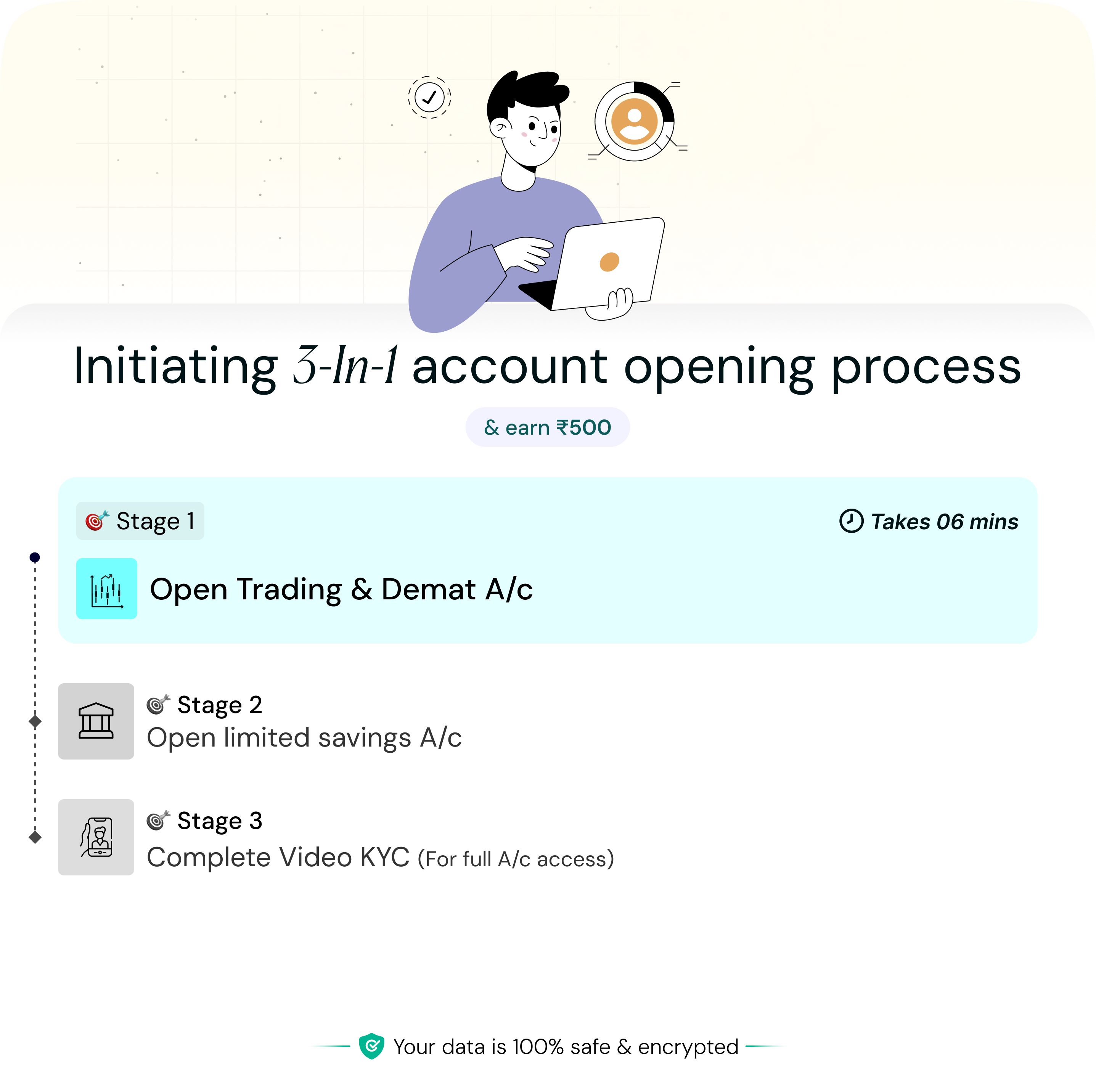
Download 3-in-1 Torus App
Trade at flat ₹11/order & Zero AMC
demat with one powerful SuperApp.

Over 1 Month
2.78%
Over 6 Months
3.89%
Over 1 Year
22.78%
Over 3 Years
72.94%

State Bank of India Summary

Close ₹1,000.70
Open ₹998.10
High ₹1,009.40
Low ₹993
Volume 1,37,73,978
Net Turnover (in Cr) ₹1382.05
52Wk High ₹1,234.70
52Wk Low ₹781.70
52Wk High / Low
781.70
1,234.70

State Bank of India Fundamentals

Key Financial Data

Market Cap (in Cr) ₹9,23,707.90
EPS (TTM) 86.70
Book Value (BV) 552.55
Div. Yield 1.73 %
P/E (TTM) 11.54
Price/Book Value 1.81
Delivery % 58.83 %
Face Value 1

Key Ratios

PE Ratio 11.30
PB Ratio 1.77
EV to Sales 14.97
PEG Ratio 1.24
ROA 1.12
ROE 17.33
Debt-Equity -
Net Profit Margin -
Operating Profit Margin -

State Bank of India Financials

Profit and Loss

Particulars (in ₹ Cr.)FY 2026FY 2025FY 2024FY 2023FY 2022
Total Revenue7,16,4716,63,359.555,94,574.904,73,378.144,06,973.09
Total Expenses6,02,443.025,56,994.255,03,334.863,97,979.583,57,234.46
Profit Before Tax1,14,027.981,06,365.2991,240.0575,398.5649,738.63
Profit After Tax85,168.4779,017.1568,138.2656,558.4336,356.17
Operating Profit After Depreciation1,14,027.981,06,365.2991,240.0575,398.5649,738.63

Balance Sheet

Particulars (in ₹ Cr.)FY 2026FY 2025FY 2024FY 2023FY 2022
Fixed Assets59,771.6747,715.9746,071.6945,879.7241,032.49
Total Assets83,21,568.5773,14,185.3467,33,778.8059,54,418.3253,60,883.53
Total Shareholder's Fund5,96,130.874,87,036.764,14,939.173,58,931.323,05,588.05

Cash Flow

Particulars (in ₹ Cr.)FY 2026FY 2025FY 2024FY 2023FY 2022
Net Cash From Operating Activities38,097.3945,484.0121,632.43-86,013.6857,694.85
Net Cash Used In Investing Activities9,240.01-3,386.58-3,475.76-965.91-2,652.25
Net Cash Used In Financing Activities-3,427.14-10,736.79-9,896.286,386.38-3,844.51

Profit and Loss

Particulars (in ₹ Cr.)FY 2026FY 2025FY 2024FY 2023FY 2022
Total Revenue5,59,172.795,24,192.784,66,812.823,68,718.663,16,021.20
Total Expenses4,53,696.014,28,921.523,85,029.863,01,513.012,72,599.35
Profit Before Tax1,05,476.7895,271.2781,782.9667,205.6443,421.85
Profit After Tax80,032.0170,900.6361,076.6250,232.4531,675.98
Operating Profit After Depreciation1,05,476.7895,271.2781,782.9667,205.6443,421.85

Balance Sheet

Particulars (in ₹ Cr.)FY 2026FY 2025FY 2024FY 2023FY 2022
Fixed Assets54,163.0743,684.7142,126.3742,100.7337,467.49
Total Assets76,23,012.0166,76,053.2761,79,693.9555,16,978.5349,87,597.41
Total Shareholder's Fund5,44,442.284,41,162.123,77,246.533,27,608.452,80,088.06

Cash Flow

Particulars (in ₹ Cr.)FY 2026FY 2025FY 2024FY 2023FY 2022
Net Cash From Operating Activities31,894.1142,857.5819,021.89-91,351.8258,415.45
Net Cash Used In Investing Activities15,238.52-105.55-2,264.15-502.65-1,724.33
Net Cash Used In Financing Activities-2,802.48-13,324.33-13,855.375,201.76-5,177.51

Particulars (in ₹ Cr.)2026-032025-122025-092025-062025-03
Total Revenue-----
Total Expenses-----
Profit Before Tax26,075.5130,066.7128,656.6429,229.1226,896.82
Profit After Tax-----
Operating Profit after Depreciation-----

Particulars (in ₹ Cr.)2026-032025-122025-092025-062025-03
Total Revenue-----
Total Expenses-----
Profit Before Tax24,832.0228,355.4726,504.0225,785.2724,844.35
Profit After Tax-----
Operating Profit after Depreciation-----

State Bank of India Technicals

Support and Resistance

S3 S2 S1 Pivot R1 R2 R3
S1 992.67
S2 984.63
S3 976.27
Pivot 1,001.03
R1 1,009.07
R2 1,017.43
R3 1,025.47

Moving Average

20 SMA 968.97
50 SMA 1,021.20
100 SMA 1,064.50
200 SMA 989.30

State Bank of India Corporate Actions

State Bank of India

₹17.35/Share

Announcement Date 15 May 2026
Record Date 16 May 2026
Div Yield 1735%

State Bank of India Peer Comparison

CompanyPriceMarket Cap (in Cr)
HDFC Bank Ltd₹744.60₹11,46,508.96
ICICI Bank Ltd₹1,317.40₹9,44,838.05
Axis Bank Ltd₹1,317.10₹4,09,625.51
Kotak Mahindra Bank Ltd₹393.10₹3,90,997.27
Bank of Baroda₹267.35₹1,38,256.37

State Bank of India Top Mutal Funds Invested

State Bank of India News

Stock Alert: SBI, Aurionpro Solutions, MedPlus Health, Honasa Consumer, Bharat Wire Ropes, IOL Chemicals & Pharma

11 Jun 2026, 08:33 am

State Bank of India to convene AGM

On 18 June 2026

15 May 2026, 06:11 pm

State Bank of India approves bond issuance up to USD 2 billion in FY27

On 12 May 2026

12 May 2026, 03:11 pm

SBI slips after Q4 NII, operating profit decline sequentially

State Bank of India shares fell 5.57% to Rs 1,031 after the lender reported muted sequential profitability and weaker margins in Q4 FY26 despite improvement in asset quality.

08 May 2026, 03:07 pm

Board of State Bank of India recommends final dividend

Of Rs 17.35 per share

08 May 2026, 03:06 pm

State Bank of India Stock Analysis

  1. Annual revenue for State Bank of India increased by 6.67% to ₹5,59,172.79 crore in FY 2026 from ₹5,24,192.78 crore in FY 2025.
  2. Annual Net Profit for State Bank of India increased by 12.88% to ₹80,032.01 crore in FY 2026 from ₹70,900.63 crore in FY 2025.
  3. Promoter Shareholding in State Bank of India remains unchanged by 0.00% in the most recent quarter, from 55.03% in December 2025 to 55.03% in March 2026.
  4. State Bank of India delivered a 1-year return of 22.78% compared to the Nifty 50, which provided a return of -7.87% as of the last trading session.
  5. State Bank of India share price moved up by 0.94% from its previous close of INR ₹1,000.70. The latest State Bank of India share price is INR ₹1,010.15.
  6. State Bank of India share price today has been at a low of 1,008.45 and a high of 1,018. Over the past 52 weeks, the State Bank of India share price has seen a low of 781.70 and a high of 1,234.70.

About State Bank of India

State Bank of India (SBI) is an Indian multinational, public sector banking and financial services statutory body. With a legacy spanning over many years, SBI offers a comprehensive range of banking products and services. Their services will include retail banking, corporate banking, and investment banking. It also deals in mortgage loans, private banking, wealth management, and insurance.
Operating within the banking and financial services sector, SBI stands as the largest bank in India. It was officially founded on July 1, 1955, but its roots trace back to the Bank of Calcutta, established in 1806. The bank’s headquarters are located at State Bank Bhavan, Nariman Point, Mumbai, Maharashtra, India.
The Government of India is the primary promoter of the State Bank of India. It holds a majority stake in the bank. This significant government backing underscores SBI’s pivotal role in the Indian banking scene. The bank’s main products include retail and corporate banking. It provides services in investment banking, mortgage loans, and private banking. The bank also serves wealth management, risk management, and asset management. It deals in banking services regarding mutual funds, credit cards, and insurance.
SBI is the largest bank in India by assets and holds a dominant market share. The leading position is denoted with 23% of the market by assets and a 25% share of the total loan and deposits market. This makes SBI a crucial player in the Indian banking sector. The Government of India’s majority stake in SBI highlights its importance and stability. This has helped SBI demonstrate strong financial performance. The economic performance has reflected its robust operational capabilities.
The registered office of SBI is located at State Bank Bhavan, Nariman Point, Mumbai. Key management figures include Challa Sreenivasulu Setty (Chairman) and Kameshwar Rao Kodavanti (CFO).

Practices of State Bank of India

The State Bank of India(SBI) has a history that dates back over centuries. This fact makes it one of the oldest banking institutions in India. Its origins can be traced to the establishment of the Bank of Calcutta in 1806, which was later renamed the Bank of Bengal. This institution was one of the three presidential banks. The others were the Bank of Bombay (established in 1840) and the Bank of Madras (established in 1843). These banks were created to serve the needs of the British East India Company. They played a crucial role in the economic development of colonial India.
In 1921, these three presidential banks were merged to form the Imperial Bank of India. The Imperial Bank became the largest commercial bank in the country. The Imperial Bank of India was influential in the Indian banking sector. It provides a wide range of banking services. The bank acted as a central bank before the establishment of the Reserve Bank of India in 1935.
The turning point in the history of the Imperial Bank of India came in 1955 when it was nationalized and renamed the State Bank of India. This move was part of the Indian government’s broader strategy. It was done to extend banking services to rural and semi-urban areas. This way, the bank promoted financial inclusion and supported economic development. The nationalization of SBI marked the beginning of a new era in Indian banking. It focused on serving the broader population’s needs rather than just the elite.
SBI’s influence grew significantly in the decades following its nationalization. The bank expanded its network of branches across the country, reaching even the most remote areas. This growth was crucial in bringing banking services to millions of Indians. These Indians had previously been excluded from the formal financial system. SBI’s efforts in this regard have been instrumental in promoting financial literacy in India.
In addition to its domestic operations, the State Bank of India also expanded its presence internationally. The bank established branches and subsidiaries in various countries. It is present in the United States, the United Kingdom, Canada, and several countries in the Middle East and Asia. This international expansion has helped SBI to serve the needs of the Indian movement. The idea was also to facilitate international trade and investment.
One of the key milestones in SBI’s history was the merger with its associate banks in 2017. These associate banks were the State Bank of Bikaner & Jaipur and the State Bank of Hyderabad. The State Bank of Mysore, State Bank of Patiala, and State Bank of Travancore were also included. These banks were also nationalized in 1959 and operated as subsidiaries of SBI. The merger of these banks with SBI created a banking giant with a vast network of branches. It created a significant market share in the Indian banking sector.
The State Bank of India has a rich history that reflects the broader economic and social changes in India over the past two centuries. SBI has played a pivotal role in the development of the Indian banking sector. Its influence extends beyond banking. The bank has been a key player in promoting financial inclusion and adopting new technologies. It remains a cornerstone of the Indian financial system and a symbol of the country’s economic progress.

FAQ’s

What is the share price of State Bank of India today?

State Bank of India share price as on 12 Jun 2026 is ₹ 1010.15

What is the Market Cap of State Bank of India?

The market cap of State Bank of India stock is ₹9,23,707.90 Cr.

What is the PE Ratio of State Bank of India?

The Price to Earnings (P/E) Ratio of State Bank of India is 11.30

What is the PB Ratio of State Bank of India?

The Price to Book (P/B) Ratio of State Bank of India is 1.77

What is the 52 week high of State Bank of India Share Price?

The 52 week high of State Bank of India share price stands at ₹1,234.70

What is the 52 week low of State Bank of India Share Price?

The 52 week low of State Bank of India share price stands at ₹781.70

How can I buy shares of State Bank of India?

Simply open a demat account with Torus Digital and place an order to buy shares of State Bank of India.

Get started with us today and
start building your wealth journey

*By clicking, I agree to the T&C and Whatsapp updates.

Get started with us today and
start building your wealth journey

*By clicking, I agree to the T&C and Whatsapp updates.
Accessibility options
Font Size

Contrast